

The Seven Pointed Star Structure
Part 5 in the Story Structure Series

07/14/2026
Thank you, always, to our dear Paid Subscribers and to everyone who comes to Flash Club (free every Thursday night on Zoom).
Subscribe to stay in the loop, and if you’re able, consider going paid.
We keep this thing running ourselves, with a lot of time, heart, and hustle, and your support helps keep it alive.
(This is part 5 in Nina’s Story Structure series)
Why is 7 the luckiest number? Why does the Bible call it the “perfect number”? Why does George R.R. Martin give us The Seven as the new gods? And finally—why did Christine Byl choose seven fragments for her essay “Bear Fragments”?
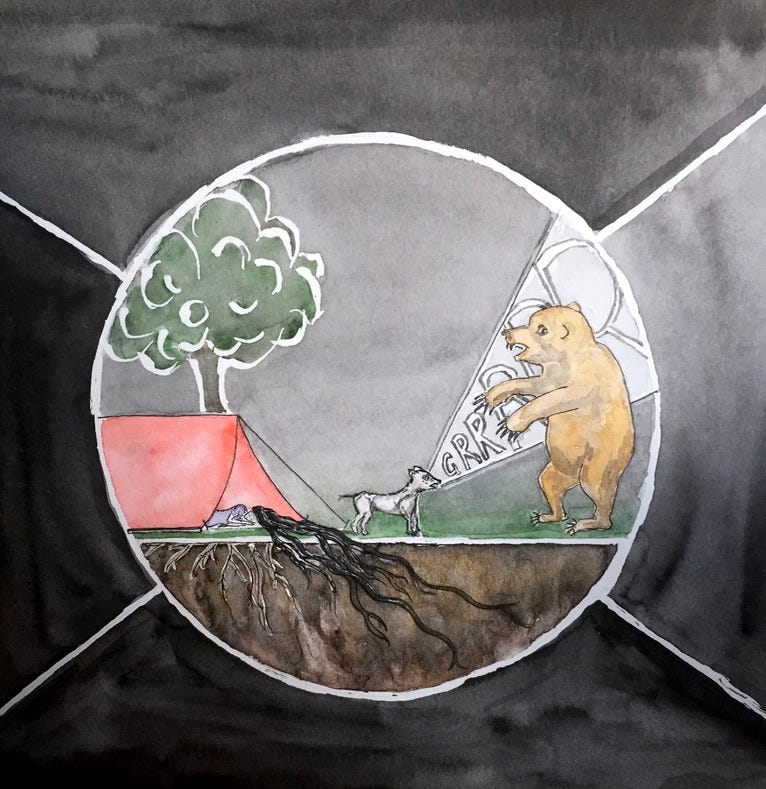
Last week I was teaching this particular story as part of my class on setting for the Acadia Writers Workshop (which runs all summer long on Wednesday mornings here in Bar Harbor at Hidden Barn Books).
I thought I had prepared well. Partway through, though, I realized I didn’t actually know why seven. As a teacher, that is embarrassing. So now I will over-correct and tell you more about the number seven than you ever wanted to know—and also how it can be extremely useful in your writing.

According to the Farmer’s Almanac, these are the basics:
Officially adopted by Emperor Constantine in A.D. 321, the seven-day week actually goes back thousands of years.
The seven-day week started with the first civilizations of the Middle East. Mesopotamian astrologers designated one day for each of the seven most prominent objects in the sky—the Sun, the Moon, and the five major planets visible to the naked eye.
The Jews also adopted a seven-day cycle, based on the time it took the Lord to create the universe as reported in Genesis. A new wrinkle in their week was the Sabbath, a day set aside for rest. This was the first time a culture had invented a holiday that occurred on a regular basis, unrelated to natural phenomena.
The Bible uses the number 7 more than any other causing Bible scholar Umberto Cassuto in his book, From Adam to Noah: A commentary on the Book of Genesis to say, “To suppose that all these appearances of the number seven [in The Bible] are mere coincidence is not possible. This numerical symmetry is, as it were, the golden thread that binds together all the parts of the section [Genesis].”
Reader’s Digest says, “In both Islam and Judaism, there are seven heavens. Muslim people walk around the Kaaba seven times while making the pilgrimage to Mecca. Seven represents harmony encompassed by yin, yang, and the five elements in Confucianism. There are seven higher worlds and seven underworlds in Hinduism. In Buddhism, the newborn Buddha takes seven steps.”
It is one quarter of the moon’s cycle—full moon to new moon and back again—And the easiest to track for the whole earth in any season. Nature’s timepiece.
Interestingly, cognitive psychologist George A. Miller of Harvard University's Department of Psychology published research in 1956 arguing that the number of objects an average human can hold in short-term memory is 7.
In April 2014, Alex Bellos a British journalist released the results of a survey that asked 44,000 people to name their favorite number. The number seven came in first, with nearly 10% of participants choosing it.
“Seven is the only number among those we can count on our hands (1-10) that cannot be divided or multiplied within the group,” Bellos explains. One, two, three, four, and five can each be doubled to reach two, four, six, eight, and ten. Nine is divisible by three. Seven, then, is the only number between two and ten that is neither a multiple nor a factor of the others. In this way, “lucky number seven” stands alone—and we grasp this implicitly.
“It’s unique, a loner, the outsider. And humans interpret this arithmetical property in cultural ways,” Bellos says. “By associating seven with a group of things, you kind of make them special too. The point here is that we’re always sensitive to arithmetical patterns, and this influences our behavior—even if we’re not conscious of it.”
So historically, astronomically, and maybe even unconsciously, we understand that there are 7 parts to a whole perspective. George RR Martin’s 7 New Gods of The Mother, The Father, The Smith, The Maiden, The Crone, The Stranger, and The Warrior can be overlayed on the to 7 Modern Psychological Perspectives of psychodynamic (unconscious drives), behavioral (observable responses), cognitive (mental processing), humanistic (self-actualization), biological (genetics and brain chemistry), evolutionary (natural selection), and cross-cultural (societal influences) perspectives used to understand the human condition.
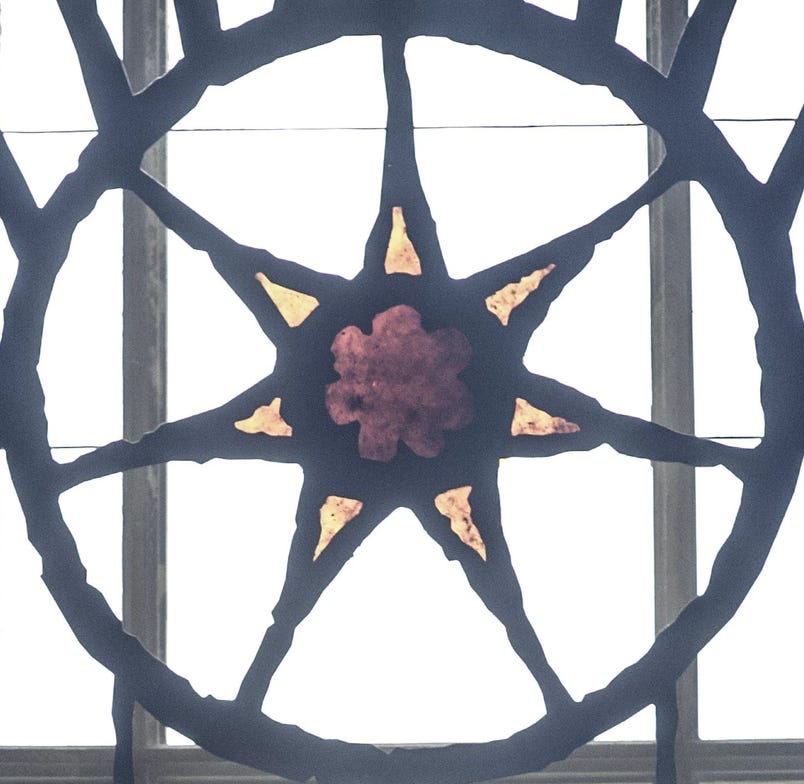
It gives us a satisfying answer to the question:
Why are we the way that we are?
or
Why am I like this?
Or, in Christine Byl’s case, she uses seven perspectives to inquire about a bear in “Bear Fragments.” Interestingly, Byl never settles on a single meaning of “bear.” She rotates through psychological, cultural, scientific, linguistic, experiential, mythic, and sensory frames so the creature remains irreducible—simultaneously threat, kin, biological machine, figure of speech, attacker, wet-nurse, and pure wild odor. The fragments each carry equal weight; because of this, they accumulate and create a WHOLE.
There is something about that word irreducible that moves me.
I think that’s what 7 does.
I struggle with social media, news, and popular influence. I feel most of what I see is reductive. We make quick social and political judgments based on sound bites, pictures, and popular perspectives. I often think… there is more to this story… and am left with the sense that I don’t understand what’s really going on.
I fight against my own reduction of self…and others (yes, mea culpa).
I think Christine is inviting us to do the same with her story on bears.
I hope you’ll join me in being irreducible by writing your own.
Ciao,
Nina
Prompt Time:
The Seven Pointed Star— 7 Perspectives on a living, breathing being
Let’s do it.
Pick a living, breathing noun.
Write about this living, breathing noun from 7 different vantage points using or not using suggestions below.
The 7 paragraphs/fragments should be of roughly equal length.
Pick from this list… or one of your own making. Groups of 7 are everywhere.
Consider Byl’s perspectives: psychological, cultural, scientific, linguistic, experiential, mythic, and sensory
Consider George R.R. Martin’s The Mother, The Father, The Smith, The Maiden, The Crone, The Stranger, and The Warrior
Consider the 7 Modern Psychological Perspectives: psychodynamic, behavioral, cognitive, humanistic, biological, evolutionary, and cross-cultural
Consider the days of the week
Consider time: deep past, middle past, recent past, the present, the near future, the middle future, the far future
Consider perspectives of others: a family member, a neighbor, a politician, a doctor, a child, a dog, a friend
Consider Point of View: first person singular, first person plural, second person, close third person, third person omniscient, cosmic third person, cinematic third
…
Here are the other structures in the series.
First, I wrote about funnel stories—narratives that narrow toward a single event.

Then I wrote about field stories—narratives that expand outward into systems, communities, and ecosystems of meaning.

Following that came the spiral structure using the Fibonacci sequence to pattern the movement closer to the center.

And then FRACTALS!

We’d Love for You to Join us at Flash Club!
Thursday Flash Club
Weekly on Zoom!
- Prompts, mini craft lessons, and community.
- Keeps us writing, talking, and trying new things.- Totally, 100%, absolutely free! Subscribe to get the link every Thursday night.