

How "Field" Story Structures Work
Story Structures #2 (Gabriel Garcia-Marquez, Daniel Mason, Elizabeth Strout, David Mitchell)

05/19/26
Thank you, always, to our dear Paid Subscribers and to everyone who comes to Flash Club, free every Thursday night on Zoom.
Subscribe to stay in the loop, and if you’re able, consider going paid.
We keep this thing running ourselves, with a lot of time, heart, and hustle, and your support helps keep it alive.
“A town is a thing like a colonial animal. A town has a nervous system and a head and shoulders and feet. A town is a thing separate from all other towns alike. And a town has a whole emotion. How news travels through a town is a mystery not easily to be solved. News seems to move faster than small boys can scramble and dart to tell it, faster than women can call it over the fences.” ― John Steinbeck, The Pearl
A few weeks ago I wrote about Funnel Story Structures.

These are stories that narrow. Stories that pull characters toward a single event horizon. The closer the story gets to the end, the tighter the walls become. The pressure increases. Cause and effect intensify. Pages turn themselves. Everything bends toward one inevitable moment.
Think about Snow White and the Seven Dwarfs. The question is simple: will Snow White survive the Queen and return to life with true love’s kiss?
The whole structure organizes around that singular endpoint. The poisoned apple. The glass coffin. The prince arriving. Even the forest chase exists to feed the momentum toward resurrection. The story behaves like gravity.
sidebar: What fascinates me as a writer is how little agency Snow White actually has inside the structure. The Queen acts. The huntsman chooses. The dwarfs protect. The prince arrives. Snow White mostly endures. She sings. She cleans. She trusts. She dies beautifully. The story happens to her because the structure itself is carrying her toward inevitability.
Funnels are powerful because they create velocity. They answer a singular narrative question. Will the shark kill Brody? Will Frodo destroy the ring? Will Michael Corleone become his father? Will Romeo and Juliet be together? The audience feels the narrowing and if you’ve done it right, they compel the reader to keep turning pages (the writers’ ultimate goal is to be consumed—more on that another time).
But lately I’ve become fascinated by a very different kind of structure. The field story.
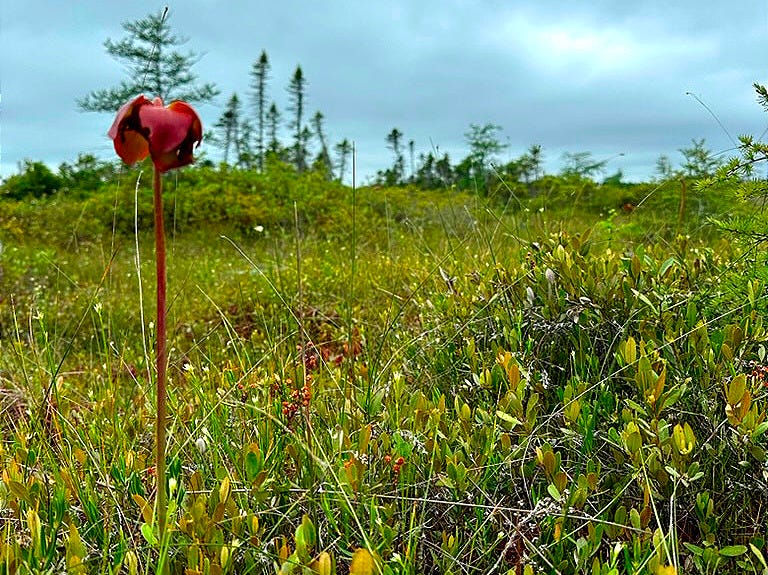
Unlike a funnel story, field stories organize around a living system.
A town.
A family.
A bog (see above picture of the prettiest bog- located in Orono, Maine)
A generation.
A social atmosphere.
A collective wound (Covid, gack!).
The movement in a field story comes from accumulation rather than narrowing.
What does that mean?
I like to think about field stories as if they were a local newspaper. You pick it up and in it are the local headlines, obituaries, letters to the editor, sports victories and losses, a calendar of social events, the police beat, weather, municipal announcements, maybe even an excerpt from the historical society on what was happening 100 years ago. This attention to the whole establishes an ecosystem of social pressure, memory, events, interactions that tell the story of what this town (or system) is like.
Daniel Mason’s North Woods is a field story. The house and the woods become the continuity system while generations of people move through them like weather. The novel keeps asking larger questions about inheritance, decay, solitude, desire, colonization, ecology, and time itself. Characters emerge and disappear, but the field remains alive.
Elizabeth Strout’s Olive Kitteridge functions similarly. Olive matters deeply, but the real subject is the emotional ecosystem of Crosby, Maine. Loneliness moves through the town almost like groundwater. Shame moves through it. Aging. Marriage. Regret. The stories speak to one another quietly beneath the surface.
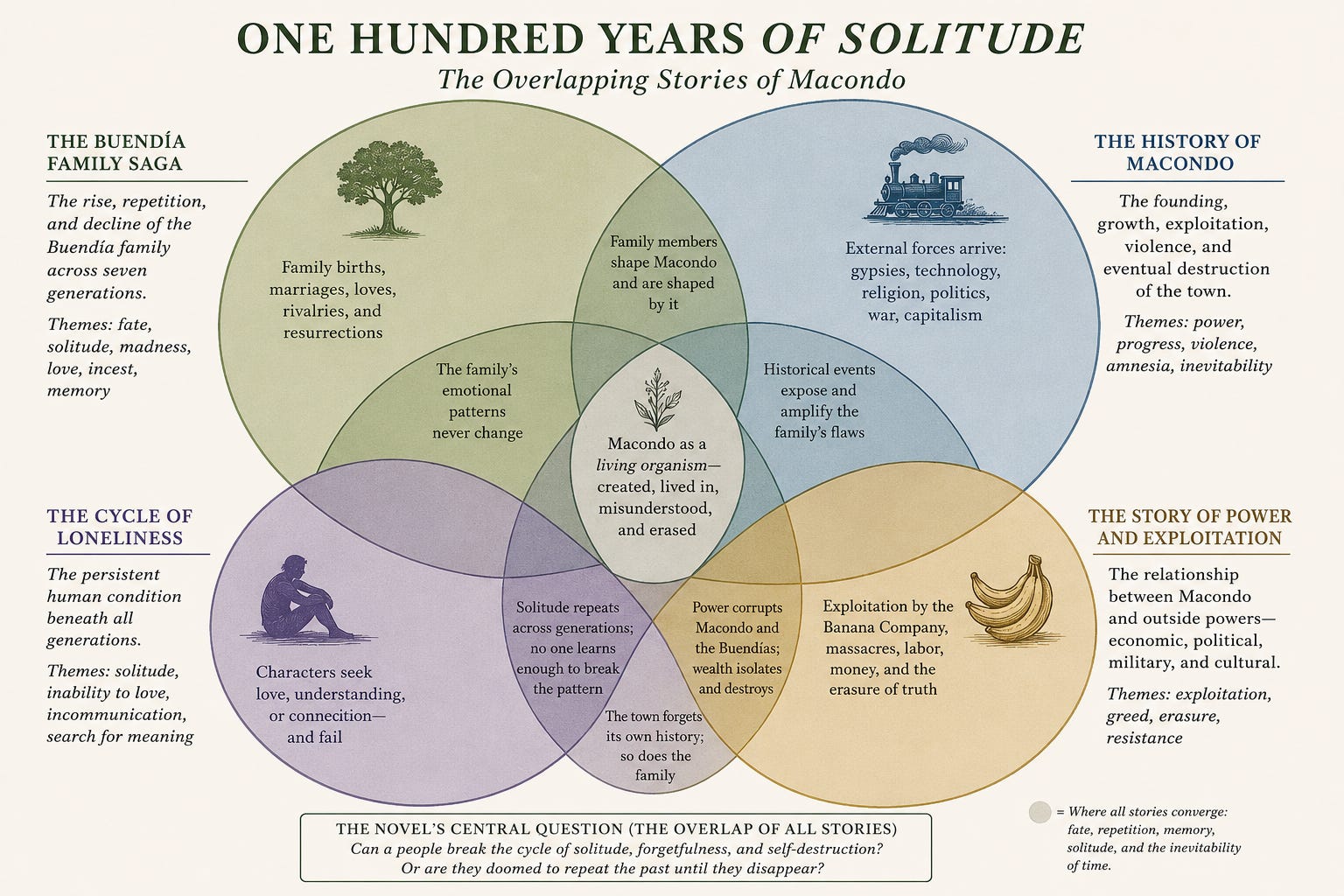
Gabriel García Márquez’s One Hundred Years of Solitude may be one of the greatest field stories ever written. The true protagonist is Macondo itself. The Buendías become recurring expressions of obsession, solitude, violence, longing, and repetition moving through generations. History in that novel behaves like weather. The same mistakes recur under slightly different names.
Then there’s David Mitchell’s Cloud Atlas, which creates a field across time itself. The book keeps asking what carries forward through human history: exploitation, power, greed, reincarnation, resistance, love. The characters become linked vibrations rather than simply isolated protagonists.
As a writer, this changes the way we think about scenes.
In funnel stories, scenes often exist to move the protagonist closer to—or farther from the central outcome.
In a field story, scenes deepen the field.
HOLD ON. That ^^ sentence ^^ was self referential. My B. Let me try an analogy.
A funnel story moves like a trail through the forest. Every scene gets you closer to the destination. You are walking toward the cabin, the murder, the kiss, the battle, the confession.
A field story asks you to notice the forest itself.
One scene reveals rot beneath the leaves.
Another reveals fungal networks connecting trees underground.
Another reveals animal tracks.
Another reveals how the light changes at dusk.
Another reveals that the stream flooding every spring has quietly been reshaping the land for decades.
None of those observations seem like “the plot” in isolation. But together they create a living system. By the end, you understand Oh! The forest IS the story.
This is why field stories can sometimes frustrate readers trained entirely on velocity. Readers ask, “What’s the plot?”
But the field is the plot, because it’s a story of a system.
I think this is why certain books feel more like real life. Life rarely behaves like a funnel. Most of us are moving inside fields all the time:
family systems,
towns,
politics,
economies,
friend groups,
historical moments,
gender expectations,
religious structures,
algorithms,
grief.
We absorb pressure from systems larger than ourselves.
I think the big challenge with field stories is maintaining coherence. A field without enough structure can become meaningless. Readers need patterns to hold onto. Recurrence helps. Motifs help. Shared locations help. Thematic pressure helps. Even loose field stories usually contain small funnels inside them: marriages failing, crimes occurring, love prevailing, illnesses progressing, people disappearing, homes being lost, crimes get solved.
The strongest field stories create the feeling that an entire world is thinking.
That’s what I’m interested in right now as a writer. How narrative can function more like ecology than architecture (can you tell I live in Bar Harbor?). How characters influence one another indirectly. How communities create their own identities. How stories can move laterally instead of only forward.
I think this is also why place-based fiction matters so much to me. A place remembers things. Towns develop nervous systems. Histories accumulate inside buildings and roads and waterfronts and diners and schools and restaurants. The emotional weather of a place changes the people inside it.
Ciao amici,
Nina
ps. there are bears in the Orono Bog. so. No peanut butter in your pockets or tickling little cubs.

Prompt Time:
Many very successful TV shows have a hybrid Macro-Field and Micro-Funnel structures. The Pitt. The Sopranos. The Wire. Friday Night Lights. Deadwood. The Office. Yellowstone. In each of these shows, characters are put into pressurized field systems that create mini-funnel arcs for their characters.
Brainstorm:
What is a system that you are a part of that has a cast of characters who are impacted by pressures within the system?
Define the roles in that system.
What roles work counter to each other?
What roles complement each other?
Define the pressures of that system.
social
emotional
physical
spiritual
Define what happens if the system succeeds.
Are there losers if the system succeeds?
Define what happens if the system fails.
Are there winners if the system fails?
Congratulations!
You’ve just created a TV show template, or the foundation of an epic novel.
ALSO, You’re Invited!
Thursday Flash Club — Weekly on Zoom
- Prompts, mini craft lessons, and community.
- Keeps us writing, talking, and trying new things.- Totally, 100%, absolutely free! Subscribe to get the link every Thursday night.
Open Mic! June 9th 7PM EST —Hosted by TPOW & MC’d by Stonecoast’s Matt Saccaro.
All subscribers are welcome to sign up here. «««« do eet! do eet now!
xoxoxoxoxoxoxoxoxoxoxoxoxoxoxoxoxoxoxoxoxoxoxoxoxoxoxoxoxoxoxoxoxoxoxox
also, we love these.