

Find the Verb: A Practical Guide to Fractal Story Structure
Part 4 in the Story Structure Series

6/16/2026
Thank you, always, to our dear Paid Subscribers and to everyone who comes to Flash Club (free every Thursday night on Zoom).
Subscribe to stay in the loop, and if you’re able, consider going paid.
We keep this thing running ourselves, with a lot of time, heart, and hustle, and your support helps keep it alive.
(This is part 4 in Nina’s Story Structure series)
Repeating behaviors at scale
I imagine that people ask me why I am writing about story structure. So I tell them, It’s because I desperately want to understand it—all the way down to the macrobiotic level.
Being dyslexic, I have what I call an event horizon for certain types of information. It comes in, shakes my hand, and promptly leaves.
Quite rude and very frustrating.
Somebody could explain the different structures to me all day long, but unless I’m given specific steps on how and why to access the structure at the sentence level, it will not make any sense to the writer in me.
I can recognize these structures in other works, but I struggle to make the leap in my own writing.
So, to all the imaginary people asking: I’m looking at stories and finding those very specific ways, at the sentence level, to help access the structure for my own writing, but also so I can teach it.
You see, as it turns out, I’m not the only one who has this trouble moving from theory to reality, there are quite a few of us. Sometimes it’s attention span, or confidence, or any number of things that can keep up from absorbing or accessing vital information.
I’m doing this to makes it easier; like chunking up a math problem.
“Easy for me, easy for you,” as my Nonno used to say.
…
First, I wrote about funnel stories—narratives that narrow toward a single event.

Then I wrote about field stories—narratives that expand outward into systems, communities, and ecosystems of meaning.

Last time, I wrote about the spiral structure using the Fibonacci sequence to pattern the movement closer to the center.

Now let’s get to the FRACTALS! They are SO FUN!
Wait, before I tell you about the fractal story, I need you to take a look at this balsam fir tree from my back yard.
This fir tree branch has a pattern that repeats its growth at scale. Those sweet little triplet of light green fir tips, are representative of the larger pattern of the branch. Three fresh fir shoots grow from a fan of three, on a branch that has three sets of fans running along the spine of the branch.
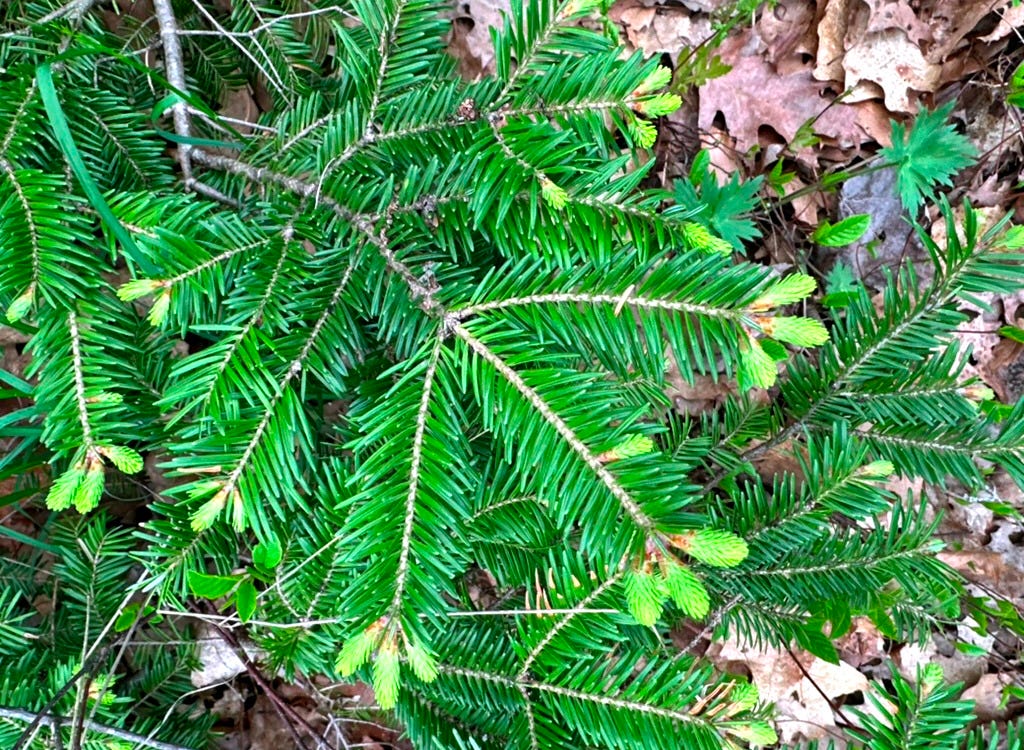
In a fractal story, the smallest scene behaves like the whole story, in the same way this tree repeats its growth pattern. The smallest action and the largest action are the same basic behavior.1
What this looks like in a story: In which Nina drafts a story, step by step, to create an example.
MICRO: a tiny behavior.
Outside June’s house on the shady side of Barberry Lane, a fir tree leans and twists itself out from under the canopy of a creaky old sugar maple to get a few moments of precious sunlight. The way the tree leans and twists makes it look as though it might topple over at any moment.
This same behavior repeats at a human (larger) scale.
Inside June’s house, her daughter Mariya with the shitty ponytail, washes up her mother and moves her from the bed to her favorite chair, then dresses her in the outfit she wore her whole life—slacks and a sweater-set and even bends over to place the brown penny loafers over the tips of her swollen feet. Her mom can’t talk anymore, but Marya talks to her because she can’t stand the silence. “I’m going to see Ray at The Breakers tonight. Said he’d buy me a drink because I was complaining about you. He said it might help me stop looking at my sneakers all the time.”

This same behavior again, at a community scale.
Sometimes Mariya thinks her mother understands her because there’s a little spark that flares and June’s eyes track her for a step or two before they go blank again. It’s this little spark that has Mariya wound tight a bobbin as she snakes her way through the crowd of tourists on her way into the little bar where every stool was taken. Ray comes out from behind the bar holding two boxes of empties and kisses her. His face drips sweat and he has three bar rags hanging from his belt. “Sorry babe, I have to work late. I forgot the cruise ship was in today.”
“Yeah, me too.”
“Can I get you a drink to-go?”
Mariya takes a gin and tonic with two limes in a coffee cup and sits in the park.
MACRO scale.
Where there is normally a panorama of the rugged coastline collapsed by time, winds from the north, and the relentless, restless sea, The Norwegian Princess sits high and proud in the foreground.
While the people who stay on board have a beautiful view of the town and Frenchman Bay, the town only sees the twenty two levels of cabin windows on the white hull. The onboard jumbotron plays the Little Mermaid while the red and blue tubes of the topside water park poke into the clouds. The trash cans overflow with the butts of ice cream cones, locals honk their horns at the oblivious visitors, and Mariya finishes her G&T in the paper cup. She balances it on the edge of the overflowing trash bin, hoping that when the public-works guys come by in the morning, they’ll appreciate that she hadn’t thrown it on the ground and given them one more reason to bend over cursing their job.
…
Notice my verb (or echoes of the verb) twist.

There’s a verb that repeats at each level. It can be changed at the semiotic level2 to become: Twist. Bend. Arch. Lean. Wrench. Coil. Curl. Reach. Swivel. Twirl. But we understand fundamentally that at each level the Object, the Character, the Community, and the Landscape are each changing shape in the face of a powerful, overwhelming force.
When you’re looking for a fractal story, ask what your object does.
Twist? Gather? Erode? Hoard? Bloom? Drift? Hide? Reach?
Once you’ve found the verb, move outward.
Find a character doing the same thing.
Then a family, town, ecosystem, or culture.
The story becomes fractal when the same behavior repeats at scale.
What are your thoughts?
Okay, the fun part…
Writing Prompt: Get all fractal like I did up there ^.
Pick a verb/behavior.
Repeat at 4 intervals of scale—increasing as I did, or decreasing for extra points.
Object » Human» Community» Environment
Reading Prompt: giggle, more reading, always more reading!!
"A Tiny Feast," by Chris Adrian - hint, the verb here is consume.
…
Ciao my lovely readers. I adore you.
Oh, and always, please forgive my typos and grammatical atrocities.
-n
We’d Love for You to Join us at Flash Club!
Thursday Flash Club
Weekly on Zoom!
- Prompts, mini craft lessons, and community.
- Keeps us writing, talking, and trying new things.- Totally, 100%, absolutely free! Subscribe to get the link every Thursday night.
This video and the “Snowflake Method” informed much of my fractal learning.
Writer and Professor of Linguistics Cara DiGiralamo mentioned this function to me the other day :)