

Short. Fast. Powerful.
Where Don Winslow meets the Ginsu 2000.

Thank you, always, to our dear Paid Subscribers and our friends at Stonecoast MFA.
We want you to know how glad we are to be part of your lives.
Tonight, we have a World Building seminar with Lucas Carroll-Garrett at 7 pm EST.
Explore bottom-up, top-down, and goal-oriented world building and learn how each approach shapes depth, tone, and narrative focus. Click the link. Do it. A free-for-all opportunity for warm, highly instructive learning brought to you by Stonecoast MFA Alums.
Salve! It’s Nina. Beware. I’m on an epic Italian-Duolingo kick. I’ll be sneaking Italian in at every opportunity. Fantastico! Andiamo!

Don’t you and St. Teresa roll your occhi at me.
This is art. Art needs inspiration. I need to write something worthwhile for me—and you.
OK, before Leah’s uh-mazing post Footnotes1, I wrote about The Long-Ass Sentence—this week, I’m writing about the incredible power of writing short!
What do I mean by writing short? Good question!
I’d like to call them short sentences, but often they aren’t even all sentences. It’s a structured layering of clauses with pauses, ellipses, em-dashes, and short sentences.
Writing short, as I call it, relies on the collection of these fabric scraps of information to make a quilt of meaning.


If you say short sentences are used for readability and pacing. You are correct. But wait—there’s more!
Sometimes writing short carries so much meaning, it slows the reader down. They pause to comprehend the meaning of everything they just took in…
I came across Don Winslow at the Jesup Library by accident. I was shelving books and thought he was a Maine writer. You see, I’m trying to read more contemporary Maine writers. He’s not, but I thought he was, and after reading the first page of his novel Savages, I brought him home.
In bed the next morning, after devouring the whole book, I discovered he’s from California—the opposite of Maine—and Holy Crap! what I’d just read had been a master-class in compression. Condensed soup. Just add water.
Here’s a tiny taste of Don Winslow from Ch.4 of Savages.
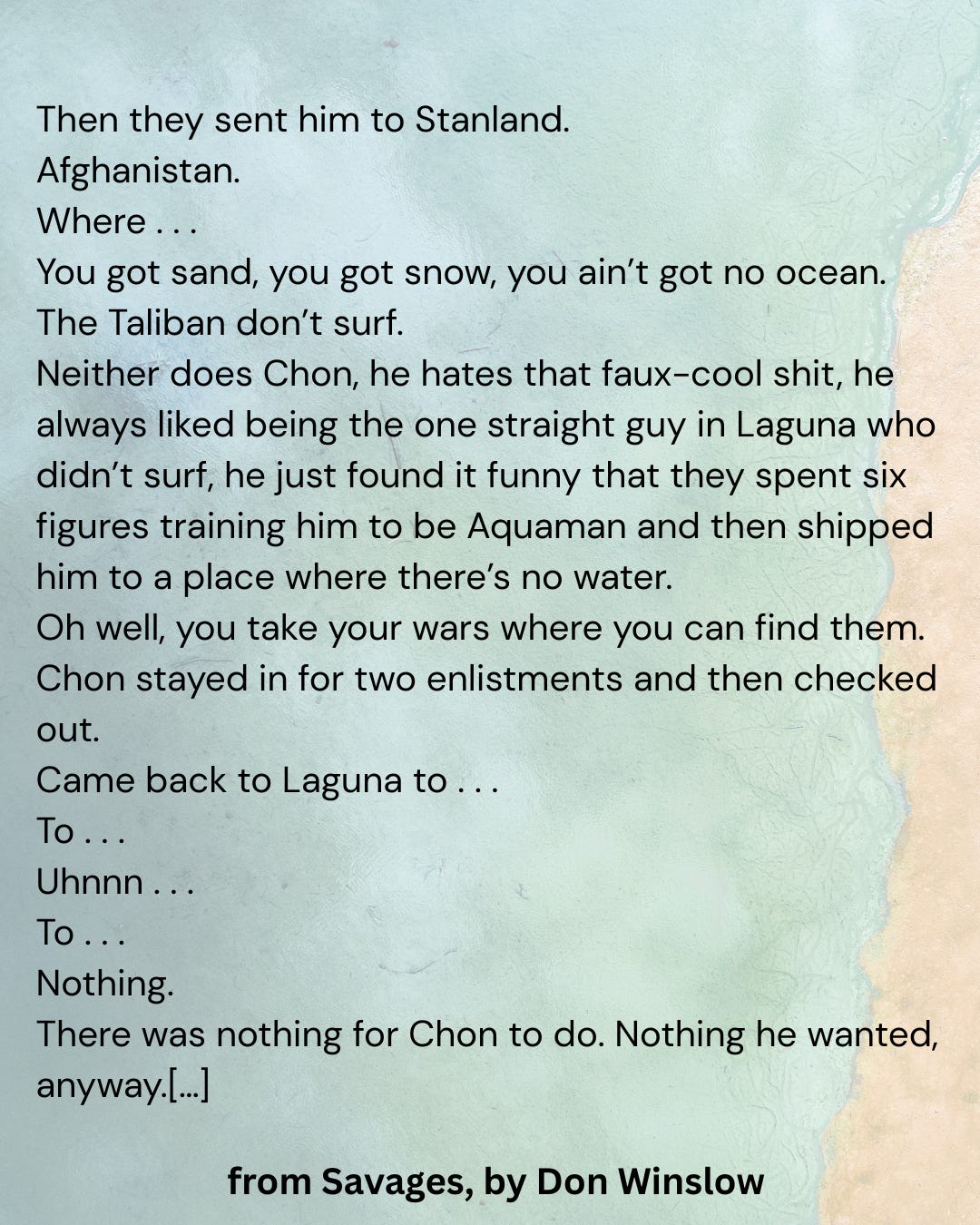
Holy smokes. Let’s look at the basic stats of this excerpt.
111 words.
12 paragraphs (less than 10 words per paragraph on average) .
7 whole sentences (1 sentence with 47 words, 2 with 11, 1 with 10, 1 with 7, 1 with 6, 1 with 4).
8 fragments.
5 sets of ellipses.
Let’s look at it annotation style…
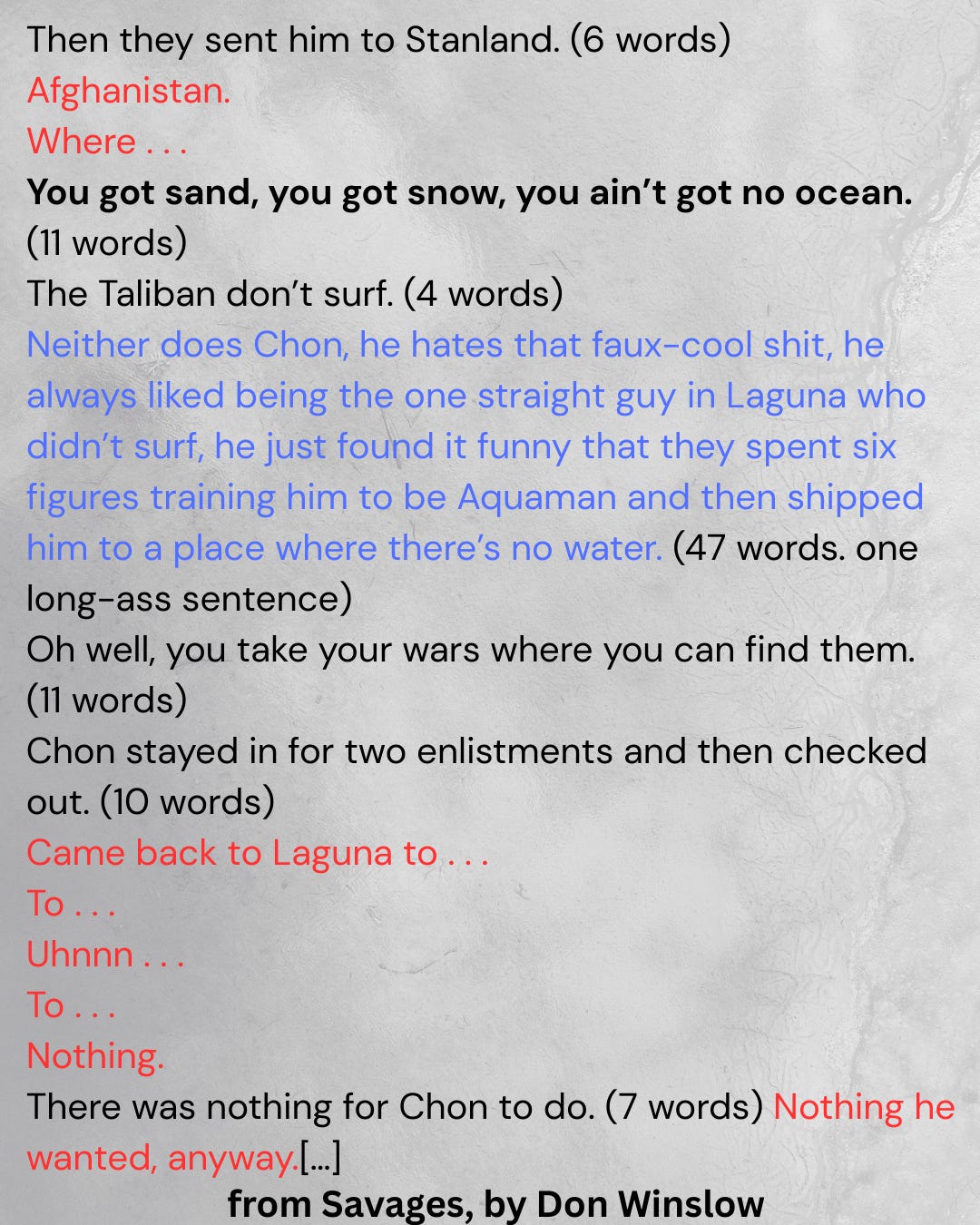
This is where structure and language converge to create VOICE. Imma try.
He talks like someone who’s…
Been there.
The paragraphs hit like radio checks. In. Out. Clear.
Seven full sentences do the heavy lifting. One long one carries the mess, the context, the contradictions. The short ones assert. The fragments brace. Ellipses buy time. They sound like a deep breath—hesitation. Gallows humor doing its quiet work.
This voice trusts momentum over explanation. It inventories, subtracts, shrugs, moves on. It withholds feeling without denying it.
You hear a friend telling it straight, fast, partial.
Competence.
Meaning later (a presto!)
Maybe never…Is it necessary?
Deceptively simple.
Under fire, language needs to carry less baggage. Where else does language need to streamline like this? War zones. Back of an ambulance. Police radio. Restaurant kitchens. At night with a screaming baby. The floor of Wall Street (wait—is that still a thing?). And, strangely enough, made-for-TV ads. Remember the infomercials for the Ginsu 2000. But wait—there’s more.
I am NOT SAYING Don Winslow is selling something cheap, I’m saying both forms understand how language behaves under pressure.
Infomercials demonstrate.
They stack simple claims on top of each other until belief forms on its own. (I made your lunch, permission slip signed, car is running.)
Winslow’s short sentences and fragments do something similar, except the product isn’t a knife, obv, it’s a credible narrative VOICE of a pressurized situation—a SoCal drug war.
Under stress, language compresses because it needs to be remembered. This is why writing short allows the reader to absorb more than the sentences seem to contain (that’s the deceptively simple part I mentioned earlier). Without explanation the reader understands emotional restraint (which paradoxically demonstrates emotional weight), narrative authority, and a moral or philosophical stance.
It blows me away.
Thanks for reading!
Arrivederci, Nina
You want to try this recipe?
Write a short pressurized scene or character backstory with very short sentences and sentence fragments (or take a scene you’ve already written and edit it with the following ingredients)
Ingredients:
Line breaks for rhythm, like poetry or jump-cut film editing
Mix in casual narration with internal thoughts, dark humor, and a laid-back but brutal (Maine/ oldfishing boat/engine blows during bad weather/poverty) vibe for extra points.
ellipses (...)
repetitions (To . . . To . . . Uhnnn . . .)
profanity, slang, and cynical asides
em-dash
Explain nothing
Make it feel fast, detached, coolly savage, and a little stoned or battle-scarred.
Oh. Present tense is a must.
Want to share? We would love to read. PLUS, we do live commentary and critiques!
Feel free to submit a piece here for a live prompt discussion or draft critique each Thursday.
Substacks I’m following in love with:
Death & Birds by Chloe Hope
Why? I’m obsessed with both death and birds.
Also her voice. Do yourself a favor and listen to the narration.

weird medieval guys —I love maps of all kinds, but these maps are delicious. Quick, my corsets are too tight, I’m swooning.
Angelique Fawns who writes Writing and Selling Stories with Angelique Fawns. IDK about you, but I have a pile of stories that I NEED to get out into the world and people who perform this service have a special place in my heart.


Upcoming at TPOW: Learning & Community
Thursday Flash Club — Weekly on Substack Live, again on Thursday, February 12th!
- Prompts, mini craft lessons, and community.
- Keeps us writing, talking, and trying new things.When Place Has Agency: Setting & Space in Fiction — Begins April 1
- Four week class on writing setting as an active force in fiction.
- Learn to use atmosphere, texture, and spatial tension to shape story.Shifting Perspectives: Mastering Point of View in Fiction — Begins April 2
- Four week class exploring First, Second, Close Third, and Omniscient.
- Perfect for experimenting with new narrative possibilities.Writing With Your Whole Nervous System — Begins May 6
- Four week class on embodiment, sensory detail, and emotional truth.
- Learn to write scenes that feel inhabited, grounded, and alive.Writing the Wild: Lyric Non-Fiction — Begins May 7
- Write from the elements: wind, water, wilderness.
- A generative class on lyric movement and the untamable.
Stonecoast Enrichment Series
World Building — February 10 - 7 pm EST ——- TONIGHT
Explore bottom-up, top-down, and goal-oriented worldbuilding with Lucas Carroll-Garrett, and learn how each approach shapes depth, tone, and narrative focus.Your Body, Your Story — March 10 - 7 pm EST
Nina B. Lichtenstein dives into the body as memory archive through sensory prompts. Learn how physical experience transforms forgotten moments into vivid scenes.Writing Words into Life! Elements & Techniques of Basic Scriptwriting — April 14 - 7 pm EST
Develop dialogue, explore the playfulness of scripts, and rediscover fun in storytelling with Adam Rodriquez-Dunn.
The Practice of Writing is a reader-supported publication. To receive new posts and support our work, consider becoming a free or paid subscriber.