

Footnotes¹²³
¹²³ Where the little piggy, the big piggy, and all the other piggies finally get to talk.

Thank you, always, to our dear Paid Subscribers and our friends at Stonecoast MFA.
We want you to know how glad we are to be part of your lives.
Howdy Writers!
“What made you decide to pepper so many footnotes through your novel?” is usually the first question I get from any fellow author who’s read my book. Some ask it joyfully, others scornfully. Footnotes seem to be a rather polarizing topic among the literary community…”
- Tal M. Klein of The Punch Escrow
When I reached out to friends to ask which fiction books they loved that used footnotes, the responses confirmed what I already suspected and what Klein clearly already knew: the outlook on footnotes as valuable, useful, or worthwhile is pretty much split down the middle.
Yep, there are plenty of writers who despise the footnote. And that’s completely fine. I see no issue with an adamant refusal of the footnote, a firm not in my house, thank you very much, sir. We all have our limits.
But for the sake of this week’s newsletter, I (Leah) want to speak in favor of them. For I am one of those who asks gleefully and geek-fully, “What made you decide to use footnotes!?” Not as a gimmick, not as an academic relic, but as a living craft tool. One that can strengthen writing through emotion, comedy, rhythm, form, and interruption. One that can surprise us and take us through parallel universes!¹
From Accuracy to Feeling
Footnotes began as servants of accuracy, not art. This is how most of us view them, organically. They were built for scholarship, designed to cite sources, verify claims, and anchor arguments to research. The German historian Leopold von Ranke helped cement the footnote as an essential tool of modern historiography, a marker of rigor and credibility.
And then, over hundreds of years, something shifted. As with most great things, the footnote started to play.²
What once existed purely to explain or prove began to carry tone, personality, subtext. Footnotes stopped serving only the intellect and began serving feeling.³
Instead of clarifying the text, footnotes began to complicate it. They became sites of emotion, humor, contradiction, dual narration, and yes, still a place to add necessary information that educates the reader. But more than that, they became side doors the writer could open without blowing a hole through the main structure.
Footnotes in Long-Form: As Architecture
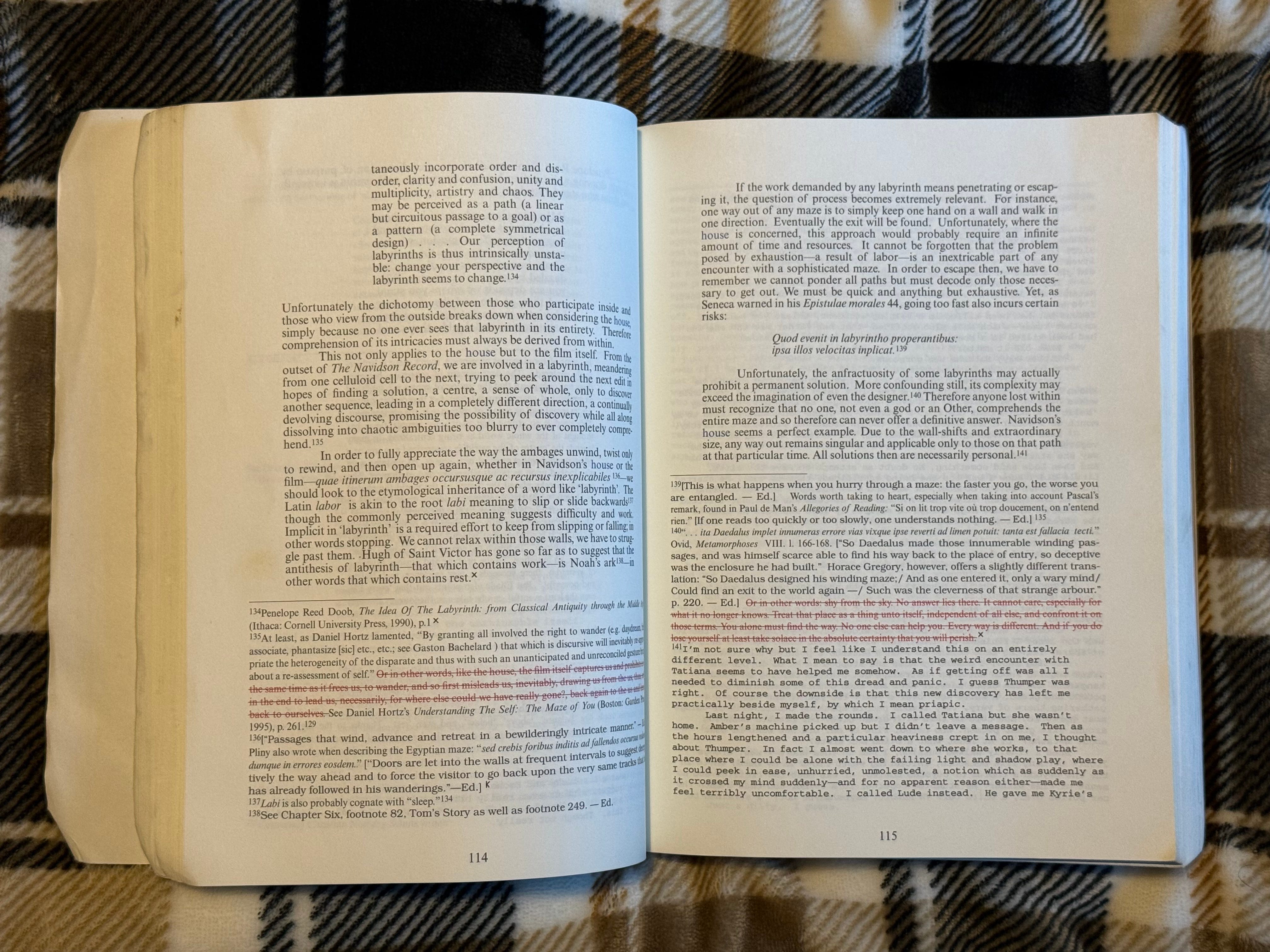
My favorite book of all time is House of Leaves by Mark Z. Danielewski (I opted in for one of his Christmas cards a few years ago, squealed with delight when it appeared in my mailbox, and then tucked it away in one of those ‘super safe spots’ that are so safe that I’ve completely forgotten where it is). Many people would argue my fascination with this book says a lot about me as a person. I’m comfortable with that. Let it sink in...⁴
Why do I love it? Well, to be as basic as possible in explaining what this book is, without giving anything away, I’d say: it is a paranormal maze within a horror maze within a deeply evocative, emotionally gripping maze.⁵ The book uses footnotes, endnotes, appendices, indexes, and typographic play to create multiple narrative layers that literally bleed into one another. The text becomes a physical experience you can’t ignore. Reading it requires movement, choice, and attention.
Here, the footnote is not an accessory.
It’s architecture. (Get it? It’s a House. A House of Leaves.)
Danielewski even shows edits within his footnotes, almost like blueprints of the house itself! (Guys, I could go on about this book for hours on end. It’s phenomenal. Go read it. Should this parenthetical be a footnote?).
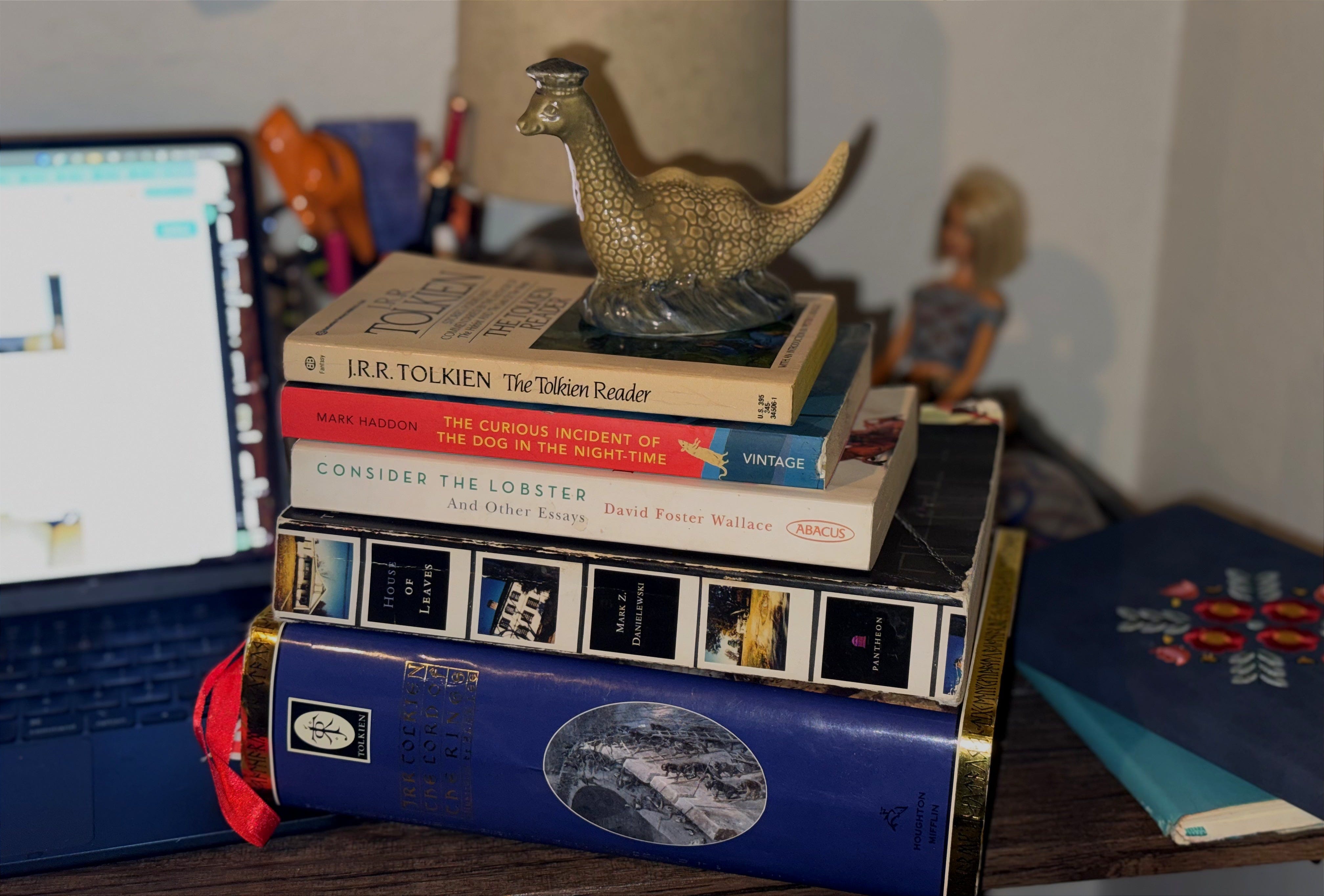
You can see similar impulses in other novels. In the work of Tolkien’s The Silmarillion, The Tolkien Reader, and even The Lord of the Rings trilogy, itself, footnotes and appendices function as world-building. They simulate history. They give the impression that the story existed long before we arrived, complete with genealogies, myths, and marginalia that make the fiction feel discovered rather than invented.
In Mark Haddon’s The Curious Incident of the Dog in the Night-Time, supplemental text mirrors cognition and consciousness.


These marginal spaces show us how a world functions and how a mind works, not just what happens to it. We are given another layer of story to further emphasize the one we’re already reading.
Short-Form Footnotes: Flash & Poetry
Of course, of course, we can’t skip over flash fiction and poetry.
This is where my love of footnotes probably peaks.
In short forms, every word is already doing heavy labor. Footnotes then become excellent compression tools. They allow parallel emotional tracks to run alongside the narrative spine. They hold what doesn’t fit without bloating the core.
In flash fiction, footnotes can contain backstory, contradiction, or emotional residue.
In poetry, they shape composition and movement. They guide us in and out of the body. White space becomes meaning. Footnotes themselves become vessels for white space.
A perfect anchor example is Seventh Circle of Earth by Ocean Vuong. The poem is composed entirely of footnotes, spaced across the page. The main text is absent. What remains is negative space, erasure, hollowness, which echoes the poem’s content (of which the physical words can be found only in the footnotes). It’s devastating and it’s brilliant.
Read Seventh Circle of Earth by Ocean Vuong Here.
In Jeanann Verlee’s poem, WHEREIN THE AUTHOR PROVIDES FOOTNOTES AND BIBLIOGRAPHIC CITATION FOR THE FIRST STANZA DRAFTED AFTER A SIGNIFICANT AND DANGEROUS DEPRESSION INCURRED UPON BEING REFERENCED AS A “HACK” BOTH BY INDIVIDUALS UNKNOWN TO THE AUTHOR AND BY INDIVIDUALS WHOM THE AUTHOR HAD PREVIOUSLY CONSIDERED FRIENDS (*)(†)(‡)(§), she features thirty footnotes attached to an eight-line poem. Definitions, asides, commentary, the whole gambit. Excess, but intentional excess! Even the title functions like a footnote. And it works because it’s by design.
(Join us February 5th, 2026 on Substack Live so we can dig deeper into Jeanann’s piece and try writing our own pieces with footnotes, too!)
In both long and short forms, footnotes can function like titles, epigraphs, or prologues. They help guide the reader. They teach us how to read.
Interruption as Strategy
So why use footnotes, especially when some readers see them as gimmicky or lazy or as detour that interrupts their flow?⁶
Because interruption, when intentional, is not failure. It’s craft.
There’s a persistent misconception, often repeated about David Foster Wallace, that his footnotes exist because he “couldn’t fit” everything into the narrative. That he was long-winded, indulgent, and excessive.
But even when space was part of the reason, the footnotes do something far more important than solve a structural problem. They hold thoughts that would derail momentum. They carry emotional states that can’t be shown cleanly in-scene. They make room for what the narrator knows but cannot say outright.
Footnotes allow for dual consciousness. They create a split between public narration and private thought. Between what is happening and what is being felt. Between what the story permits and what the author insists on whispering anyway.
Sometimes you want to preserve narrative flow. Sometimes you want to break it deliberately. Footnotes let you do both!
They are also one of the most effective ways to break the fourth wall. The author can step in, address the reader directly, and then slip back out again without hijacking the entire piece.⁷ The pause they create can sharpen tension, deepen irony, or let something land harder simply because we were forced to stop.
Footnotes vs. Endnotes
I think it’s important to see the distinction between these two, both in how they function on the page, but also how they can help direct our readers in very intentional manner.
Footnotes live at the bottom of the page and so they interrupt immediately. They demand our attention. Yes, they can be distracting, but if that pause is something we’re asking of our readers, then this is a great way to do so.
Endnotes are collected at the back and operate differently. They tempt rather than insist. They offer a choice.⁸ The reader can leave to go read the end notes, or they can resist and the anticipation builds. The reading experience changes depending on what they do.
So before using either, it helps to ask:
a) Am I willing to let my reader be distracted?
b) Do I want them to pause, or do I want them to choose?
and of course
c) Does this help my writing or does it hurt it?
Because, let’s be real, this method isn’t for the faint of heart. If it isn’t done with precision, it can be pretty disastrous.
So, Why Use Footnotes at All?
Easy. Because they allow for:
Emotion
Humor
Breaking the fourth wall/authorial presence without domination
Preserving narrative flow
Intentionally disrupting narrative flow
An Invitation, Not a Rule
Obviously: footnotes are optional. They are tools, not obligations. No one is required to love them. No one has to use them. And truth be told, you don’t have to read them either (but please do).
But they are worth experimenting with, especially in low-stakes drafts.⁹
So, let’s do a little experimenting, shall we?
¹ Surprise! (And yes, that is a Loch Ness Monster donning a traditional Scottish Bonnet)
² It’s no surprise that The Practice of Writing loves to play. In fact, it was a series of conversations about play in writing that brought us exactly here. That’s pretty much the whole reason we exist.
³ Yes. Feeling. Of course it leads here. I know. I’m obsessed. Obsessed with feeling.
⁴ Like when you’re driving to work and there’s construction and suddenly you’re two blocks east and four blocks north and you’re not enjoying this new scenic route at all and god damn it, I’m going to be late again. Why did I eat that stupid toaster waffle immediately after taking my fiber supplement? I’m going to shit my pants.
⁵ This chick is weird.
⁶ But only if I’m being super basic.
⁷ I, for one, love feeling like I’m having a side chat with the author. What did you have for breakfast today? Did you sleep well last night? Have you ever heard of a hagfish? No I’m not calling you a hagfish. Are you calling me a hagfish? How dare you?
⁸ Choose Your Own Adventure books! We love those.
⁹ One might even argue that this could be incredibly useful for writers who need to leave notes for themselves while drafting. A private practice that quietly becomes part of the reader’s experience, too.
PROMPT TIME!
Take a short piece of your own writing, a page or less, (or if you only have longer pieces, grab a manageable chunk of something).
Do not revise the main text.
Simply add one to two footnotes.
Use them to say something the original piece does not. Bring in a dual emotion or humor to cut the tension (or build it!) or break the fourth wall.
Want to share? We would love to read. PLUS, we do live commentary and critiques!
Feel free to submit a piece here for a live prompt discussion or draft critique each Thursday.
The bottom of this page is empty, but only because you haven’t given it anything to hold yet.
Don’t be such a hater. Try it out, see how it feels.
Lots o’ Love,
Leah
Stories We’re Following:
There are three things I specifically want to touch on.
I stumbled on this piece while doom-scrolling Substack (possibly the healthiest doom scroll I’ve ever experienced), and really appreciated how it acknowledges that while art can appear simple, it basically never is. The essay untangles our reflex to equate difficulty with value, especially in art, and asks what we miss when we fetishize struggle over clarity, access, or intention.
That said, Pollock still irritates the shit out of me. Apologies if that offends you.

It took far too long, but U.S. federal law now formally recognizes certain severe acts of animal cruelty as felonies under the Prevention of Animal Cruelty and Torture (PACT) Act. It feels both genuinely heartening and wildly overdue, a meaningful step forward, even if still a small one, toward acknowledging what should have been obvious all along: that these animals matter.
If you’re in the Chico area, I highly recommend stopping by MONCA (Museum of Northern California Art). They’re currently showing Perch, Flutter, and Soar, a group exhibition that includes my mom, Michelle Scott’s, work. The show explores winged creatures not just as forms, but as ideas, movement, instinct, and transformation. It’s a really beautiful, thoughtful collection, and well worth a visit.


Upcoming at TPOW: Learning & Community
Thursday Flash Club — Weekly on Substack Live, again on Thursday, February 5th!
- Prompts, mini craft lessons, and community.
- Keeps us writing, talking, and trying new things.When Place Has Agency: Setting & Space in Fiction — Begins April 1
- Four week class on writing setting as an active force in fiction.
- Learn to use atmosphere, texture, and spatial tension to shape story.Shifting Perspectives: Mastering Point of View in Fiction — Begins April 2
- Four week class exploring First, Second, Close Third, and Omniscient.
- Perfect for experimenting with new narrative possibilities.Writing With Your Whole Nervous System — Begins May 6
- Four week class on embodiment, sensory detail, and emotional truth.
- Learn to write scenes that feel inhabited, grounded, and alive.Writing the Wild: Lyric Non-Fiction — Begins May 7
- Write from the elements: wind, water, wilderness.
- A generative class on lyric movement and the untamable.
Stonecoast Enrichment Series
World Building — February 10 - 7 pm EST
Explore bottom-up, top-down, and goal-oriented worldbuilding with Lucas Carroll-Garrett, and learn how each approach shapes depth, tone, and narrative focus.Your Body, Your Story — March 10 - 7 pm EST
Nina B. Lichtenstein dives into the body as memory archive through sensory prompts. Learn how physical experience transforms forgotten moments into vivid scenes.Writing Words into Life! Elements & Techniques of Basic Scriptwriting — April 14 - 7 pm EST
Develop dialogue, explore the playfulness of scripts, and rediscover fun in storytelling with Adam Rodriquez-Dunn.
The Practice of Writing is a reader-supported publication. To receive new posts and support our work, consider becoming a free or paid subscriber.