

When are you a writer?
Micro lessons in craft, prompts to explore silence, and opportunities to deepen your writing practice

01/13/26
Thank you, as always, to our dear Paid Subscribers and our friends at Stonecoast MFA. We want you to know how glad we are to be part of your lives. Our next event, the TPOW Open Mic, is happening January (TODAY) 13 - 7 pm EST and will be hosted by editor of @typebarmagazine, Matt Saccaro.
Click here to sign up!
Open to ALL
Hello Writers! Welcome to TPOW’s Weekly Edition.
Wait…are you really a writer?
Before we get into crafting sentences, paragraphs, scenes, chapters…sometimes we need to spend a minute with ourselves.
We say things to ourselves that undermine the sentences, paragraphs, scenes and chapters, like…I’m not a real writer. A real writer is Elizabeth Strout, Ursula K. LeGuin, Octavia Butler, or that swoon-worthy Grace Paley.
Sometimes I like to play this psychological game I was taught, called self-flagellation.
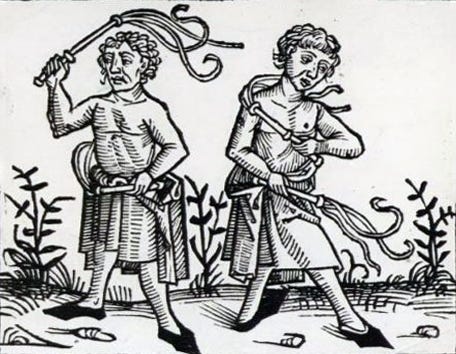
It’s been popular since at least 1493 (see above woodcut), so I’m sure you’re familiar with concept if you don’t have an inherited practice yourself. The act of berating yourself for something you have or have not done. I have a whole quadrant of my brain dedicated to this art-form. These days it’s filled primarily with reasons why I’m not a writer and will never be a writer. I go there as a regular part of my writing practice.
It’s not just me. I spent the weekend with other real writers. It’s a thing for them too.
While I can’t say it feels good or healthy, it does feel…familiar.
This practice is so popular, Saturday Night Live did a modern interpretation on the effectiveness of negative reinforcement with their popular “Pelotaunt” skit (4.1 million views and almost 2,000 comments).
Modern psychology talks about the dangers of negative self talk and how we should practice positive reinforcement.
And yet, this kind of talk, the negative kind, can be a motivator (for good or bad). It inspires us to reach for something. The comments under the video are almost all related to how this actually would work for them and how they distrust praise and cheerleading.
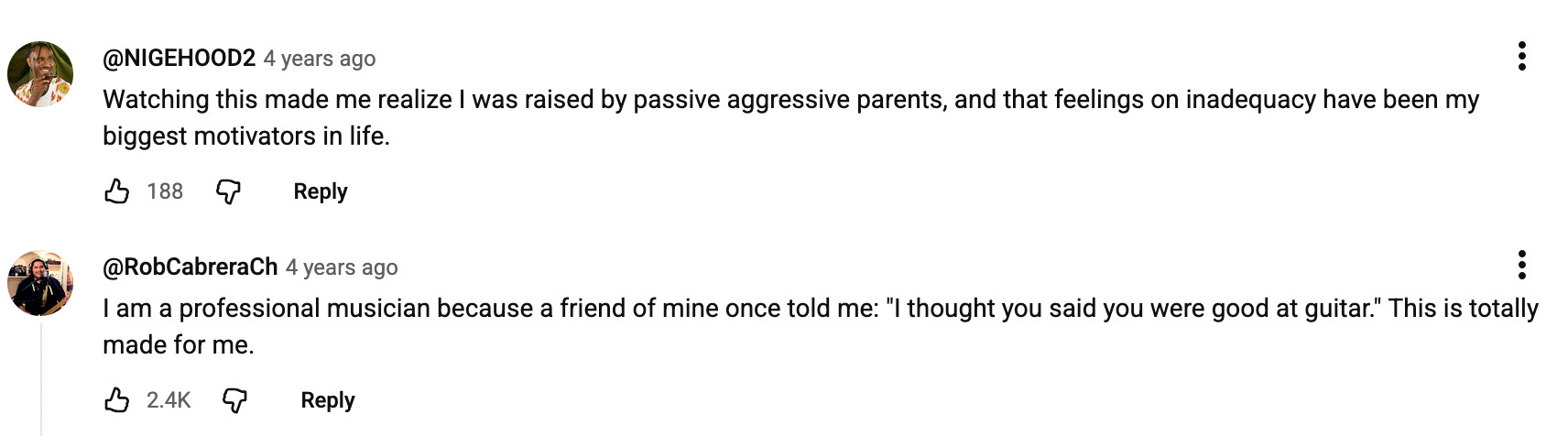
How interesting that 2,400 people responded with a thumbs-up to the above comment by RobCaberaCh.
Note: This post isn’t an argument for negative self-talk, it’s about observing it and seeing if the negative talk is of any use.
If you’re someone like me (based on the popularity of the skit and the enduring artwork—there are many of us), it’s a clue to what we want to be better at.
In Frump Feelings What Would Grace Paley Do?, Emma Copley Eisenberg tells us how THE AMAZING Grace Paley wrote mostly on “receipts and scraps of paper that she kept in her apron pocket” while she raised her children and participated in grassroots work.
I wonder if she considered herself a “real” writer.
I asked my husband if he considers himself a writer. He has sold over 150,000 copies of his local trail guide, A Walk in the Park: Acadia’s Hiking Guide and several thousand copies of Trails of History: A History of Acadia National Park. This is the benchmark that many writers aspire to achieve, and yet his answer flummoxed me. He said, “No. I’m not a writer. I was, I can do it, but I don’t do it anymore. I’m a line-cook now.”
He’s a tad more than a line cook, but I think his answer is interesting. He qualified his answer by considering only how he spends his time, not the achievements. It’s simply not his practice anymore, so he doesn’t carry the title.
I shelve books at the library, and I proudly announce my prestigous title of “book shelver” though I only do it for an hour a week.
And maybe that’s the thing.
We think the title writer is something you earn only after a certain number of hours, pages, books sold, prizes won, or years endured. We think it has to be continuous. Official. Verified. Witnessed.
Most identities don’t work that way.
You don’t stop being a parent on the days you don’t parent well.
You don’t stop being a reader because you didn’t finish a book this month.
You don’t stop being a writer because you wrote on a receipt, or a Notes app, or in ten stolen minutes at a gymnastics meet.
Grace Paley didn’t wait for perfect conditions. She didn’t wait for long mornings or quiet houses. She wrote on scraps because scraps were what life gave her. And then quietly, over time, those scraps became stories the rest of us now hold up as proof of legitimacy.
So why are we so damn reluctant to say we are writers?
For me, sometimes claiming the title feels like tempting fate, or I’m afraid someone will ask, What have you published? Or because I confuse vocation with productivity. Or because I learned somewhere that wanting something badly enough is embarrassing unless you can prove you deserve it.
So maybe the problem isn’t whether we are writers.
Maybe the problem is the word itself. Yeah! That’s it.
It’s a word that invites interrogation. A word that makes people lean back and ask follow-ups. A word that seems to demand credentials, time logs, or proof of seriousness. Say writer and suddenly you’re in a courtroom.
So instead, I hear people (writers) say other things.
I’m working on a short story.
I write when I can.
I’m between drafts.
I teach writing.
I’m trying to finish a piece.
I’m thinking about a book.
Notice how the labor is named, but the identity is not.
We do linguistic self-protection (with our self flagellation too).
Because writer sounds like a settled state, and most of us experience writing as unsettled. Ongoing. Fragmentary. Easily interrupted. Writing happens in margins, on receipts, in notes apps, in the backs of notebooks meant for something else.
I’ll just note that Grace Paley didn’t call it a career arc. She wrote where she could, when she could, and then went back to the rest of her life. The scraps came first. The stories came later. The title arrived last, if it arrived at all.
Maybe this is why self-flagellation sticks around. It’s a way of checking proximity to the thing we care about without naming it outright. A rough instrument, a hammer, but a revealing one.
If you’re reading this, it’s probably enough to tell you what you already know.
Now go write…unless you’re chicken ;)
with love,
Nina, the writer.
PROMPT:
Write a report titled: “Statement of Contact.” In it, use neutral, bureaucratic, fact based statements.
Include:
the date and location of contact with language
the duration (approximate is fine)
the medium (paper, phone, margin, voice memo, mind only)
what interrupted it
what residue remained (a phrase, an image, an irritation, a question)
Do not interpret the data.
Do not conclude anything.
End the report with this line, unchanged:
“This record is submitted without claim of identity.”
Then read it and ask yourself, “Am I a writer?”

Let us know what came of this, we’re always curious what y’all are up to. We’d love to read it.
We are also doing live commentary and critiques. Feel free to submit a piece here for a live prompt discussion or draft critique on Thursdays, each week.
Stories We’re Following:
Craft & Industry:
I made Leah listen to this one.
The Creative Penn—2026 Trends And Predictions For Indie Authors And The Book Publishing Industry with Joanna Penn
and then I read about this…as Joanna predicted, right on cue.
Harlequin Just Fired All Their Human Translators (Yikes)
Link: https://colony.litopia.com/threads/daily-book-news-tuesday-6th-january-2026.16734/
According to the New York Times recent article on 2025 books sales: Bible sales are up about 12% over last year. And comic book/graphic novels are way up - 27%.
Literary Gossip:
The Scam Emails Are Getting Sneakier
Here’s a weird one that’s making the rounds: Amazon authors are getting official-looking emails warning that titles with fewer than 10 reviews might face “reduced visibility or listing restrictions” effective 2026, from BookBrowse
Upcoming at TPOW: Learning & Community
Thursday Flash Club — Weekly on Substack Live, starting this Thursday, January 8th!
- Prompts, mini craft lessons, and community.
- Keeps us writing, talking, and trying new things.When Place Has Agency: Setting & Space in Fiction — Begins April 1
- Four week class on writing setting as an active force in fiction.
- Learn to use atmosphere, texture, and spatial tension to shape story.Shifting Perspectives: Mastering Point of View in Fiction — Begins April 2
- Four week class exploring First, Second, Close Third, and Omniscient.
- Perfect for experimenting with new narrative possibilities.Writing With Your Whole Nervous System — Begins May 6
- Four week class on embodiment, sensory detail, and emotional truth.
- Learn to write scenes that feel inhabited, grounded, and alive.Writing the Wild: Lyric Non-Fiction — Begins May 7
- Write from the elements: wind, water, wilderness.
- A generative class on lyric movement and the untamable.
Stonecoast Enrichment Series
TPOW Open Mic — January 13 - 7 pm EST TONIGHT
Hosted by editor of @typebarmagazine, Matt Saccaro.Click here to sign up! Anyone can!
World Building — February 10 - 7 pm EST
Explore bottom-up, top-down, and goal-oriented worldbuilding with Lucas Carroll-Garrett, and learn how each approach shapes depth, tone, and narrative focus.Your Body, Your Story — March 10 - 7 pm EST
Nina B. Lichtenstein dives into the body as memory archive through sensory prompts. Learn how physical experience transforms forgotten moments into vivid scenes.Writing Words into Life! Elements & Techniques of Basic Scriptwriting — April 14 - 7 pm EST
Develop dialogue, explore the playfulness of scripts, and rediscover fun in storytelling with Adam Rodriquez-Dunn.
